How to Choose the Best Local Paving Professionals

A new driveway or parking lot is one of the most expensive and highly visible exterior upgrades a property owner can make. It serves as the literal welcome mat to your home or business, immediately impacting curb appeal and setting the tone for the entire property’s value. However, because the most critical parts of a paving project are hidden beneath the surface, it is an industry where shortcuts are common and the results of those shortcuts can stay hidden until the first major storm or a change in season.
Poor installation leads to disastrous results—pooling water that seeps into your foundation, rapid crumbling along the edges, unsightly sinkholes, and total structural failure within just a year or two. Furthermore, the driveway repair industry is unfortunately a frequent target for fly-by-night scammers who disappear the moment their sub-par work begins to crack. Avoiding these costly mistakes requires more than just picking a name out of a search engine; it requires a systematic approach to vetting professionals before any contracts are signed or deposits are handed over.
By understanding your material options, verifying legal credentials, asking specific technical questions about base preparation, and demanding itemized quotes, you can confidently hire the right crew. This guide is designed to provide you with the technical knowledge and interviewing strategies needed to ensure your next surface is durable, flawless, and built to last for decades.

Evaluate Your Terrain to Decide on the Right Surface Material
Before you start picking up the phone to call for quotes, you must first assess your specific needs, your regional climate, and your long-term budget. Choosing the wrong material for your geography can lead to a surface that fails prematurely, regardless of how well it was installed. You must consider the freeze-thaw cycles of your area, the weight of the vehicles that will be parked on the surface, and how much maintenance you are realistically willing to perform over the next twenty years.
Climate is perhaps the most significant factor in this decision. In regions that experience harsh winters with heavy snow and ice, flexibility is the key to longevity.
-
Thermal Absorption: Darker surfaces naturally absorb more sunlight, which helps melt snow and ice much faster than lighter-colored materials. This can be a major safety benefit for sloped driveways.
-
Expansion and Contraction: Flexible materials can shift slightly as the ground freezes and thaws without snapping or shattering. This is a primary reason why so many homeowners in northern climates prioritize asphalt driveways for their residential properties.
-
Weight Distribution: Consider the heaviest vehicle that will regularly use the surface. A standard passenger car requires a different structural thickness than a heavy-duty delivery truck or an RV.
While flexibility is great for movement, some property owners require the rigid, high-load-bearing strength of stone-based mixtures. If your property is situated on completely flat terrain and you are looking for a highly customized aesthetic—such as stamped patterns, integrated colors, or a clean, white finish—you may find that a standard asphalt company is not the right fit for your vision. In these cases, your search should focus on specialists who handle rigid pours. These materials offer incredible durability and can last thirty to fifty years if maintained, though they are more prone to cracking in areas with extreme temperature swings if the sub-base isn’t perfectly engineered.

Build a Shortlist by Tapping into Neighborhood Resources
Once you have a general idea of the material you want, the next step is building a shortlist of reputable candidates. This is the stage where most people are vulnerable to the most common industry scams. Every year, “traveling” crews move through neighborhoods knocking on doors, claiming they have “leftover material” from a large commercial job nearby and offering a one-time-only discount.
You should never, under any circumstances, hire a paving professional who initiates contact at your front door. High-quality crews are almost always booked weeks or months in advance and do not need to solicit work door-to-door. Instead, look for businesses with deep roots in your community. Sourcing recommendations for local paving companies ensures that the crew is familiar with the specific soil types in your town—whether it is heavy clay or sandy loam—and understands the municipal permitting laws required for curb cuts and drainage.
A reliable shortlist should come from a variety of verified sources:
-
Neighbor Referrals: Look for driveways in your neighborhood that were installed three to five years ago and still look pristine. Ask the owner about their experience with the crew’s punctuality and clean-up.
-
Community Message Boards: Local digital forums can be a goldmine for honest reviews, but be wary of “one-review” accounts that might be shills for the business.
-
Professional Showrooms: Visit local material yards and ask the staff who they recommend. These suppliers see which contractors pay their bills on time and which ones are consistently ordering high-quality aggregates.
If your project is more complex than a simple rectangular driveway—perhaps involving the installation of structural retaining walls to hold back a slope or intricate concrete curbs to manage water flow—you may need more than a general laborer. In these instances, you should look for dedicated concrete contractors. These specialists possess the heavy forms and specialized finishing equipment necessary for complex masonry and structural work that a standard paving crew might not be equipped to handle. By gathering a diverse list of specialists, you can ensure the right tools are brought to your specific site.

Audit Licenses, Insurance, and Previous Portfolios
Once you have three to five names on your list, it is time to perform a “paperwork audit.” This step is non-negotiable. Paving involves heavy machinery, high temperatures, and significant property alteration. If an accident occurs on your property and the contractor is not properly covered, you as the homeowner could be held liable for medical bills or property damage.
Start by asking for their state-issued license number and verify it on your state’s official website. A legitimate local contractor will have no problem providing this information. Beyond the license, you must demand proof of two specific types of insurance:
-
General Liability: This covers damage to your home, your neighbor’s property, or underground utility lines during the construction process.
-
Workers’ Compensation: This is critical. If a worker is injured while operating a steamroller or handling hot materials on your driveway, this insurance ensures they are covered, preventing them from seeking damages from your homeowner’s insurance policy.
Once the legalities are out of the way, look at the “physical” evidence of their work. The condition of a crew’s equipment is a direct reflection of their professionalism. If the trucks are leaking oil all over your street and the rollers look like they haven’t been maintained in a decade, it is a sign that they may be cutting corners on your project as well.
Finally, ask every prospective paving contractor for a list of local addresses where they completed work several years ago. Don’t just look at the glossy photos on their website of a “freshly black” driveway. Drive by the older jobs. Look for signs of “alligator cracking” (cracks that look like scales), significant fading, or areas where the edges are crumbling. A surface that looks great after one week but falls apart after two winters is a sign of a crew that doesn’t understand the importance of sub-grade compaction. Seeing how their work ages is the most honest testimonial you can get.
Interrogate Their Methods for Base Preparation and Drainage
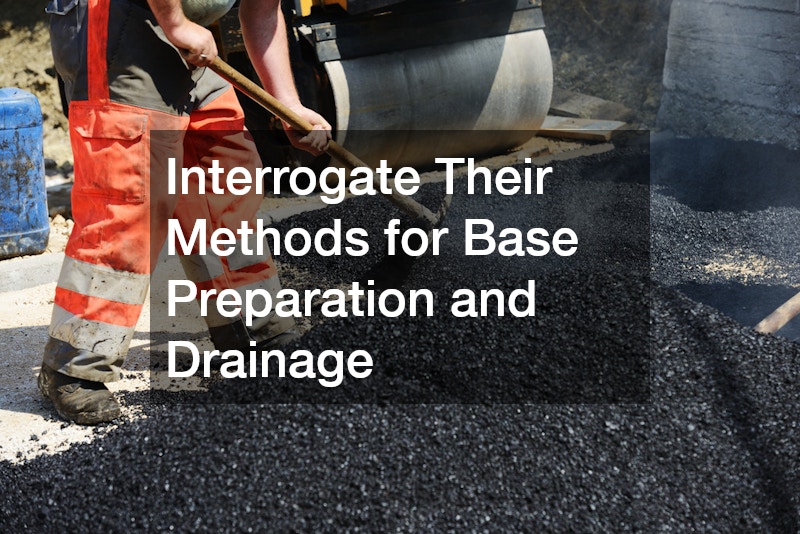
The most expensive mistake you can make is focusing only on the top layer of the driveway. In reality, the surface you see is only about 10% of the structural integrity of the project. A driveway is only as strong as the foundation beneath it. When interviewing your shortlist, you must ask technical questions about their methods for base preparation. If a contractor tells you they can just “pour over” your old, cracked surface without digging it up, you should thank them for their time and move on to the next candidate.
Proper installation requires a deep excavation of the existing soil to reach a stable sub-grade. You should ask exactly how deep they plan to dig and what type of aggregate they use for the “crushed stone” base. A standard residential driveway usually requires 4 to 8 inches of compacted stone base before the top material is even considered.
Drainage is the second pillar of a successful project. Water is the primary enemy of all paved surfaces. If water is allowed to pool in the center or run toward your garage door, the driveway will fail rapidly.
-
Establishing the Grade: Ask the contractor how they plan to ensure a minimum 2% slope away from your structures.
-
Edge Compaction: In asphalt paving, the edges are the most vulnerable part of the driveway. Ask if they use a hand-tamper or a specific vibratory plate to reinforce the edges so they don’t break off when a car tire gets too close to the grass.
-
Advanced Stabilizers: For properties with soft, “spongy” soil or areas with existing drainage issues, ask if they utilize paving fabric installations. These are high-tech geotextile layers placed between the soil and the stone base. They provide extra structural support, prevent the stone base from sinking into the mud over time, and act as a weed barrier.
While many homeowners focus on the aesthetics, a reputable concrete company or paving specialist will spend the majority of their time talking about the “invisible” work. If they are more interested in talking about the color of the sealer than the thickness of the gravel base, their priorities are in the wrong place. A quality job starts from the bottom up.
Demand Itemized Estimates and Scrutinize the Fine Print
By the time you reach the final stage of your search, you should have at least three written quotes to compare. Never pick a contractor based on a verbal “handshake” agreement or a price scribbled on the back of a business card. A professional estimate should be a multi-page document that protects both parties.
When comparing bids, do not automatically choose the lowest number. In the paving industry, a significantly lower price almost always means a thinner surface layer or a recycled, low-quality aggregate base. You want to see “apples to apples” comparisons. A professional quote from a reputable local paving company should include the following:
-
Total Square Footage: Exactly how much area is being covered?
-
Compacted Thickness: How many inches of stone base and how many inches of finished surface material are being promised after compaction?
-
The Scope of Work: Does the price include the removal and disposal of the old driveway? Does it include the cost of permits?
-
The Schedule: When will the work start, and how long will the driveway be “off-limits” for parking?
Understanding the payment terms is the final hurdle. Scammers often demand the full amount or a large “cash” deposit upfront to buy materials. A trustworthy asphalt company with established credit at local material yards will typically only ask for a small deposit (usually 10% to 20%) to secure your spot on their calendar. The bulk of the payment should only be due upon the satisfactory completion of the work.
Finally, read the warranty carefully. Does it cover “cosmetic” cracks or only “structural” failures? A one-year warranty is standard, but some of the best companies will offer a two or three-year guarantee on their workmanship because they are confident in their base preparation. Once you are satisfied with the terms, ensure every detail—from the drainage slope to the final cleanup—is in writing before you sign.
Securing Your Investment
Choosing the right professionals to pave your property is a significant responsibility that requires patience and a bit of technical detective work. By taking the time to evaluate your terrain, tapping into local neighborhood referrals, and strictly auditing the legal and professional credentials of your candidates, you effectively eliminate the risks that plague so many homeowners.
The secret to a driveway that lasts for decades isn’t a “magic” material; it is the integrity of the people who install it. When you insist on proper base preparation, verify the use of advanced stabilization techniques, and demand highly detailed, itemized contracts, you are doing more than just buying a new driveway. You are investing in a long-term asset that will enhance your daily life and protect your property’s value for years to come.
Take the first step toward your new surface today by walking your current driveway and noting where the water pools. Talk to your neighbors about their experiences and start your research into the specific soil and climate challenges of your property. With the right team behind the machinery, your new driveway will be a source of pride, not a source of stress.